 JLV College Counseling
Scholarship Saturday – October 11, 2014
The deadlines for the scholarships that were on this list have passed. To see scholarships that are still accepting application, visit more recent Scholarship Saturday posts.
Over 1,000 Starbucks employees to start classes at ASU
Starbucks Coffee by StephenGilmer licensed by CC BY-ND 2.0
On Tuesday Starbucks and Arizona State University announced that over 1,000 Starbucks employees would start classes at ASU this fall. The students from all over the U.S. will be starting online classes on Oct. 15 as part of the Starbucks College Achievement Plan.
In June, Starbucks announced employees, or partners, based in the U.S. who work an average of at least 20 hours per week are eligible to participate in the program. Partners admitted to ASU with junior or senior standing will earn full tuition reimbursement to complete their bachelor’s degree. Partners with freshman or sophomore standing will be eligible for partial tuition scholarships, as well as need-based financial aid. In addition to reimbursement for tuition costs, partners will also have a dedicated enrollment coach, academic adviser, and financial aid counselor. Starbucks partners can attend ASU Online part time or full time.
Starbucks partners receive a scholarship up front that covers some of the cost of attendance. In addition, partners are required to submit the Free Application for Federal Student Aid (FAFSA). Each time partners at junior or senior standing complete 21 credit hours, they will be reimbursed for the full cost of tuition and mandatory fees. The company says their reimbursement will automatically show up in their paycheck.
Starbucks has said partners will have no commitments to Starbucks after they complete their degree. Therefore, partners will not need to repay scholarships or continue working at Starbucks after completing their degrees. While many corporate educational benefit programs usually come with specific major requirements, Starbucks partners are able to major in whatever they choose. ASU Online has 40 online undergraduate programs available to students. Starbucks announced the most popular majors this semester are business, education, organization leadership, and psychology.
Starbucks said they chose ASU Online because their mission, values and brand are similar to Starbucks. ASU President, Michael Crow, said, “ASU is thrilled to welcome more than 1,000 Starbucks partners to the Sun Devil family.” He continued, “we are proud that this public-private partnership will enable Starbucks partners to achieve the dream of a college degree and the lifetime of advantages that an ASU education provides.”
Want to stay in the loop? Subscribe to my Examiner.com column to be notified when new articles are published. You can also follow me on Twitter, Facebook or Pinterest for information on college admissions.
FAFSA college list shared with colleges
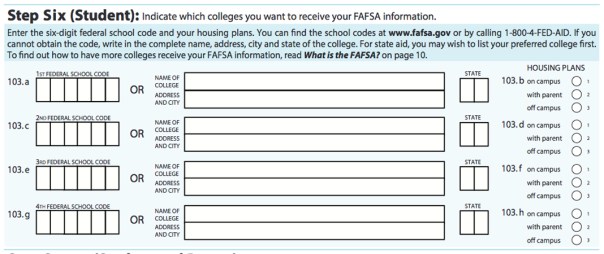
Students can list up to 10 colleges when filling out the electronic version of the FAFSA
When students fill out the Free Application for Federal Student Aid (FAFSA), one piece of the application includes listing the colleges the students plan to apply for admission. Students are asked to list up to 10 colleges on the electronic version of the FAFSA to send their financial information. For most colleges, students must submit the FAFSA to be considered for financial aid. However, unbeknownst to the students, the list and order of the colleges is also made available to the institutions and is sometimes used during the admissions and financial aid process.
The FAFSA does not instruct students to put the colleges in a specific order. However, many students are placing the colleges in order of their preference. The National Association for College Admission Counseling (NACAC), an organization of college counselors and admissions officers, has asked the federal government to stop providing this information to institutions. The organization believes some colleges are using the information to disadvantage some students who apply for admission and financial aid. They also say some colleges are using the position in which they are placed on a student’s list to determine admissions decisions, wait list placement, and the size of the financial aid award.
The U.S. Department of Education said last year it will review the longstanding policy, but no changes have been made. On Thursday, NACAC sent an email message to members regarding this issue explaining their stance that institutions should not receive this information, and if they do, the list should be random or in alphabetical order. Some admissions officers, on the other hand, have expressed the important of this data. By looking at the order of the list, institutions can predict yield, the number of admitted students who will ultimately attend their institution.
In the email to members, NACAC said, “while students may volunteer this information, the association believes that a student’s right to keeping such information private is an integral part of maintaining a fair admission process.” Even if the Department of Education does not make a change to the policy, NACAC’s discussion of the policy and the use of the information is making its way to school counselors and students. While most colleges do not use the information to disadvantage students, they should be aware this information is being shared with colleges and ask admission officers how their institutions use the information.
Want to stay in the loop? Subscribe to my Examiner.com column to be notified when new articles are published. You can also follow me on Twitter, Facebook or Pinterest for information on college admissions.
Scholarship Saturday – October 4, 2014
The deadlines for the scholarships that were on this list have passed. To see scholarships that are still accepting application, visit more recent Scholarship Saturday posts.
Scholarship Saturday – September 27, 2014
The deadlines for the scholarships that were on this list have passed. To see scholarships that are still accepting applications, visit more recent Scholarship Saturday posts.
Buy Me a Coffee

Book Pick of the Month

The link for the book is an affiliate link. You will not pay extra; however, I do receive a small reimbursement if you purchase through the links. Thank you for your support of JLV College Counseling.


 JLV College Counseling