 JLV College Counseling
15 Calif. community colleges receive initial approval to offer four-year degrees

Santa Monica College—SMC by Mrgates licensed by CC BY-SA 3.0
Santa Monica College was among one of the 15 Calif. community colleges that receive initial approval to provide a bachelor’s degree program.
The California Community Colleges Board of Governors met today in Sacramento to discuss a number of items, including offering baccalaureate degree programs. Chancellor Brice W. Harris provided a list of 15 bachelor’s degree programs he recommended to the board for approval. This change will make California the 22nd state to offer bachelor’s degree programs at community colleges. Under legislation authored by State Senator Marty Block, only degree programs that are not currently offered by the University of California or California State University campuses are eligible to be offered at community colleges.
Vice Chancellor of Academic Affairs Pamela D. Walker explained the process of how the list of 15 recommended programs were selected from the 34 applications received by the deadline. In just 30 days, colleges were required to create a proposal for the degree program and provide extensive information to the chancellor’s office. The colleges were required to articulate a description of the program, evaluate student interest and community support, research labor market and labor demand, have conversations with CSU and UC campuses to demonstrate collaboration, and research and avoid duplications with UC and CSU majors. The colleges were also required to illustrate upper division course work and identify resources to demonstrate college capacities.
Over 250 individuals were approached to be readers of the bachelor’s degree program proposals. Overall, as least 200 hours went into reviewing each proposal, much of which happened during the holiday break. Readers scored each application on a number of criteria including geographic distribution, diversity of the programs, and the potential of duplication with CSU and UC campuses.
The programs recommended to the board for initial approval were diverse. Foothill College in Los Altos Hill and West Los Angeles College in Culver City both proposed Dental Hygiene. Modesto Junior College proposed Respiratory Care and Skyline College in San Bruno proposed Respiratory Therapy. Health related recommendations included Health Information Management at San Diego Mesa College and Shasta College in Redding, Emergency Services & Allied Health Systems at Crafton Hills College in Yucaipa, and Occupational Studies at Santa Ana College. Technology related programs included Airframe Manufacturing Technology at Antelope Valley College in Lancaster, Industrial Automation at Bakersfield College, Biomanufacturing at MiraCosta College in Oceanside, and Automotive Technology at Rio Hondo College in Whittier. The rest of the recommended programs were Mortuary Science at Cypress College, Equine Industry at Feather River College in Quincy, and Interaction Design at Santa Monica College.
The Board of Governors provided their initial approval with nine votes in favor and two abstentions. They will now meet individually with each of the successful college to complete the review and consultation process. The 15 programs will then be brought back to the board in March for final approval. Once final approval is given, colleges will be required to start the programs by the 2017-2018 academic year.
Education Summit for college bound students coming to CSU East Bay

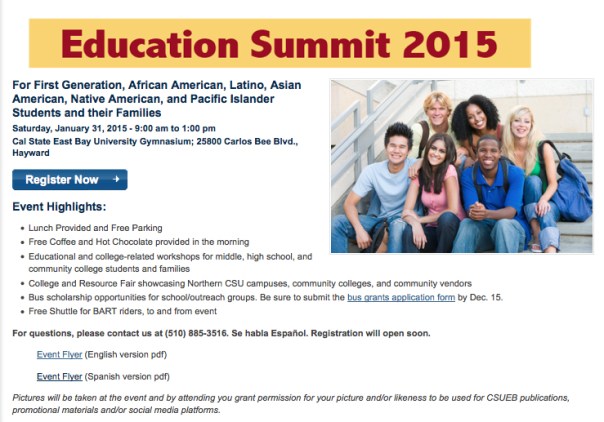
Education Summit 2015 at CSU East Bay
California State University, East Bay is hosting Education Summit 2015 on Jan. 31, 2015. The event is geared towards first generation, African American, Asian American, Latino, Native American, and Pacific Islander students and their families. The event will give attendees an opportunity to hear from inspirational speakers, attend educational, college and career related workshops, and stroll through a college and resource fair.
Event Details
Education Summit 2015
Saturday, Jan. 31, 2015
9:00 a.m. – 1:00 p.m.
California State University, East Bay
25800 Carlos Bee Blvd.
Hayward, CA 94542
Campus event location: Gymnasium
Highlights
- Educational and college and career related workshops for Middle, High School and Community College students and their families.
- College and Resource Fair – Northern CSU campuses, community colleges and area vendors will have booths at the fair.
- Admissions and financial aid information.
Resources Available
- Free parking – a real plus because at many college campuses, visitors have to pay to park! Attendees are encouraged to park in Lots A, B, D or E for convenient access to the event.
- Free coffee and hot chocolate in the morning
- Free lunch in the afternoon
- Free shuttle for BART riders to and from the event
Students looking to attend college should find this event a great resource to learn more about college, gain tips about admissions and financial aid for college, and learn about all of the resources available for first generation and minority college students.
To attend, students are encouraged to register before the event.
Scholarships with February 2015 deadlines
The deadlines for the scholarships that were on this list have passed. To see scholarships that are still accepting applications, visit more recent Scholarship Saturday posts.
UMass Amherst and Amazon team up to create virtual bookstore for students

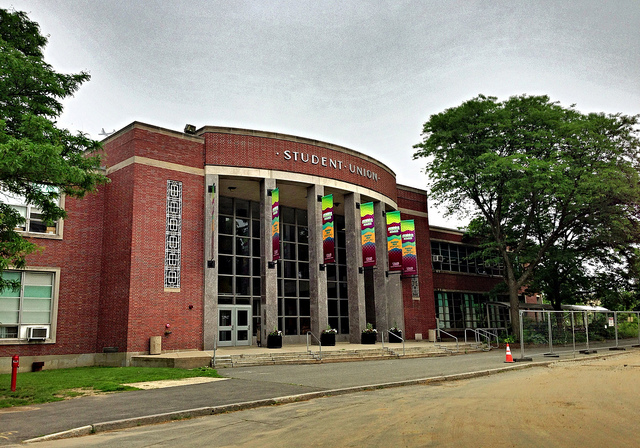
UMass Amherst by Trace Meek licensed under CC BY 2.0
The University of Massachusetts Amherst announced today they have contracted with Amazon.com to provide a virtual bookstore for their students. The Amazon.com virtual bookstore will replace the traditional bookstore that is currently on the campus. According to the announcement, there is a potential for students to save an average of $380 per year.
According to James P. Sheehan, Vice Chancellor of Administration and Finance at UMass Amherst, the university knows students have been struggling with the cost of textbook and have been moving towards purchasing book online. UMass believes that “by seamlessly linking our online campus information system to Amazon, we will make it convenient as well as economical for students to get the items they need for their classes, delivered in one day with no shipping charge to campus and nearby addresses.”
Students will be able to start using Amazon.com to find their textbooks in May. Amazon will allow students to order new, used, rental and digital textbook and other materials through their website. In addition, there will be links in SPIRE, UMass’s online student information system. To make it even easier for students, Amazon will open a staffed customer pick-up and drop-off location on the UMass campus in the current textbook annex.
While there will be a customer service location on campus, students can also choose to have items shipped to campus or their homes. UMass students will receive one-day free shipping to campus and to addresses in nearby communities where many students live. Other items not required or recommended for courses will not be eligible for free one-day shipping. However, if students are Amazon Student or Amazon Prime members who typically receive free two-day shipping, they will now be able to get non-academic items with free one-day shipping to campus or the surrounding communities.
Officials at UMass Amherst said they chose Amazon from a group of six companies that submitted proposals. They said they chose Amazon “because of its low prices and its ability to deliver superior customer service.” In addition to providing a virtual bookstore for students, Amazon will also work with faculty “to college information on required and recommended textbooks and course materials each semester.”
Previously the bookstore on campus was run by Follett Corp. and had items such as textbooks, clothing, and computers available for sale. Follett Corp. will still sell clothing and computers on campus, but textbooks will only be available through Amazon.
This is Amazon.com’s third virtual bookstore contract with a university. They are currently working with Purdue University and the University of California, Davis. There is no news of other universities who are working with Amazon, but this may be a new trend in how students get their college textbooks.
Want to stay in the loop? Follow this blog to be notified when new articles are published. You can also follow me on Twitter, Facebook or Pinterest for information on college admissions.
Buy Me a Coffee

Book Pick of the Month

The link for the book is an affiliate link. You will not pay extra; however, I do receive a small reimbursement if you purchase through the links. Thank you for your support of JLV College Counseling.


 JLV College Counseling
