 JLV College Counseling
Super Bowl 50 Fun: College Alma Maters of the Players

 On Feb. 7, 2016, millions of people will be watching Super Bowl 50. The Denver Broncos and Carolina Panthers will be competing for the Vince Lombardy Trophy and the title of Super Bowl Champions. For fun, I thought it would be interesting to see what colleges the players from both teams attended before playing in the NFL.
Not surprisingly, many of the players attended “big name” colleges – known for their athletic and academic programs. However, there are some who attended less well-known colleges. Some players attended community colleges before transferring to four-year colleges, while others transferred from one four-year university to another four-year institution. And, one player did not even play college football. Below are the colleges the players from each team competing in Super Bowl 50 attended before they entered the NFL.
Denver Broncos
Quarterbacks
Peyton Manning: University of Tennessee
Brock Osweiler: Arizona State University
Trevor Siemian: Northwestern University
Running Backs
C.J. Anderson: Laney College (Community College) | University of California, Berkeley
Ronnie Hillman: San Diego State University
Juwan Thompson: Duke University
Wide Receivers
Andre Caldwell: University of Florida
Bennie Fowler: Michigan State University
Cody Latimer: Indiana University
Jordan Norwood: Pennsylvania State University
Emmanuel Sanders: Southern Methodist University
Demaryius Thomas: Georgia Institute of Technology
Tight Ends
Owen Daniels: University of Wisconsin-Madison
Vernon Davis: University of Maryland
Virgil Green: University of Nevada
Offensive Line
Sam Brenner: University of Utah
James Ferentz: University of Iowa
Max Garcia: University of Maryland | University of Florida
Evan Mathis: University of Alabama
Robert Myers, Jr.: Tennessee State University
Matt Paradis: Boise State University
Louis Vasquez: Texas Tech University
Defensive Line
Ryan Harris: University of Notre Dame
Malik Jackson: University of Southern California | University of Tennessee
Darius Kilgo: University of Maryland
Tyler Polumbus: University of Colorado at Boulder
Michael Schofield: University of Michigan
Antonio Smith: Oklahoma State University
Vance Walker: Georgia Institute of Technology
Sylvester Williams: University of North Carolina at Chapel Hill
Derek Wolfe: University of Cincinnati
Linebackers
Shaquil Barrett: University of Nebraska, Omaha | Colorado State University
Todd Davis: Sacramento State University
Brandon Marshall: University of Nevada
Lerentee McCray: University of Florida
Von Miller: Texas A&M University
Corey Nelson: University of Oklahoma
Shane Ray: University of Missouri
Danny Trevathan: University of Kentucky
DeMarcus Ware: Troy University
Cornerbacks
Lorenzo Doss: Tulane University
Chris Harris, Jr.: University of Kansas
Taurean Nixon: Tulane University
Bradley Roby: The Ohio State University
Aqib Talib: University of Kansas
Kayvon Webster: University of South Florida
Safeties
Josh Bush: Wake Forest University
Shiloh Keo: University of Idaho
Darian Stewart: University of South Carolina
T.J. Ward: University of Oregon
Special Teams
Aaron Brewer: San Diego State University
Britton Colquitt: University of Tennessee
Brandon McManus: Temple University
Carolina Panthers
Quarterbacks
Derek Anderson: Oregon State University
Cam Newton: University of Florida | Blinn College (Community College) | Auburn University
Joe Webb: University of Alabama at Birmingham
Running Backs
Cameron Artis-Payne: Allan Hancock College (Community College) | Allan Hancock College
Jonathan Stewart: University of Oregon
Mike Tolbert: Coastal Carolina University
Brandon Wegher: Morningside College | University of Iowa
Fozzy Whittaker: University of Texas at Austin
Wide Receivers
Brenton Bersin: Wofford College
Philly Brown: The Ohio State University
Jerricho Cotchery: North Carolina State University
Devin Funchess: University of Michigan
Ted Ginn, Jr.: The Ohio State University
Kevin Norwood: University of Alabama
Tight Ends
Ed Dickson: University of Oregon
Greg Olsen: University of Notre Dam | University of Miami
Scott Simonson: Assumption College
Offensive Line
Ryan Kalil: University of Southern California
Andrew Norwell: The Ohio State University
Michael Oher: University of Mississippi
Mike Remmers: Oregon State University
Chris Scott: University of Tennessee
Trai Turner: Louisiana State University
Fernando Velasco: University of Georgia
Daryl Williams: University of Oklahoma
Defensive Line
Mario Addison: Northeast Mississippi Community College | Troy University
Jared Allen: Idaho State University
Ryan Delaire: Towson University
Kony Ealy: University of Missouri
Dwan Edwards: Oregon State University
Charles Johnson: University of Georgia
Star Lotulelei: University of Utah
Kyle Love: Mississippi State University
Kawann Short: Purdue University
Linebackers
Thomas Davis: University of Georgia
Ben Jacobs: Fresno State University
A.J. Klein: Iowa State University
Luke Kuechly: Boston College
David Mayo: Texas State University
Shaq Thompson: University of Washington
Cornerbacks
Cortland Finnegan: Samford University
Robert McClain: University of Connecticut
Josh Norman: Horry-Georgetown Technical College (Tech College) | Coastal Carolina University
Teddy Williams: University of Texas at San Antonio (did not play football)
Lou Young: Georgia Institute of Technology
Safeties
Tre Boston: University of North Carolina at Chapel Hill
Kurt Coleman: The Ohio State University
Roman Harper: University of Alabama
Colin Jones: Texas Christian University
Dean Marlowe: James Madison University
Special Teams
Graham Gano: Florida State University
J.J. Jansen: Notre Dame University
Brad Nortman: University of Wisconsin-Madison
Any surprises? Did any of them attend a college you are considering? Let me know by leaving a comment.
Scholarships with March 2016 deadlines

Scholarships closing dates have passed. Check out scholarships that are currently accepting applications and submissions here.

Attending college can be quite expensive for students and their families. Luckily, there are many college scholarships and contests available to help pay for a college education. Students should seek out and apply for scholarships in which they meet the eligibility requirements. Below are 130 college scholarships and contests with deadlines in March 2016.
Only brief information about each scholarship is listed. Therefore, students are encouraged to visit the scholarship websites to get further details about eligibility and requirements.
*Note: As I find more scholarships, they will be included in the Scholarship Saturday posts – don’t forget to follow my blog to get notified every time an article is posted.
2016 Annual Student Essay Contest
Sponsor: Americans United For Separation of Church and State
Amount: Up to $500
Deadline: March 1, 2016
Description: Contest is open to United States high school seniors and undergraduate students. Applicant must submit an essay on a topic related to separation of church and state.
2016 Pride in Your Heritage GRHS Youth Essay Contest
Sponsor: Germans from Russia heritage Society (GRHS)
Amount: Up to $1,000
Deadline: March 1, 2016
Description: Contest is open to students attending public, private, parochial, or home schools, and to students attending accredited universities. Student must submit an essay on a topic related to German Russian history, heritage or culture. Student does not need to be ethnic German-Russian to enter contest.
AACL Scholarship
Sponsor: Armenian-American Citizens League Educational Fund
Amount: Up to $2,000
Deadline: March 1, 2016
Description: Scholarship is open to permanent residents of the United states who have been living in California for at least two years and are of Armenian descent. Applicant must be enrolled full-time at an accredited college in the United States and maintain at least a 3.0 GPA.
ABFSE Undergraduate Scholarship
Sponsor: American Board of Funeral Service Education
Amount: Up to $2,500
Deadline: March 1, 2016
Description: Scholarship is open to students who have completed at least one semester (or quarter) of study in a program in funeral service or mortuary science education accredited by the American Board of Funeral Service Education.
ACS Scholars Program
Sponsor: American Chemical Society (ACS)
Amount: Up to $5,000
Deadline: March 1, 2016
Description: Scholarship is open to African American, Hispanic/Latino, and American Indian students who are graduating high school seniors or college freshmen, sophomores or juniors intending to or already majoring in chemistry, biochemistry, chemical engineering or a chemically related science.
American Council of the Blind Scholarship Program
Sponsor: American Council of the Blind (ACB)
Amount:
Deadline: March 1, 2016
Description: Applicant must be a legally blind student who is a graduating high school senior enrolling in higher education in the fall, or a current undergraduate, graduate or vocational student.
Anchor Scholarship
Sponsor: Anchor Scholarship Foundation
Amount: $2,000
Deadline: March 1, 2016
Description: Scholarship is open to family members (children or spouses) of qualified Surface Navy sailors.
Barbara Wiedner and Dorothy Vandercook Peace Scholarship
Sponsor: Barbara Wiedner and Dorothy Vandercook Memorial Scholarship Foundation, Inc.
Amount: Up to $500
Deadline: March 1, 2016
Description: Applicant must be a high school senior or college freshman who can provide evidence of leadership and/or personal initiative in activities or in an organization relating to peace and social justice, nuclear disarmament, and/or conflict resolution.
Benjamin A. Gilman International Scholarship Program
Sponsor: Bureau of Educational and Cultural Affairs at the U.S. Department of State
Amount: Up to $5,000
Deadline: March 1, 2016
Description: Scholarship is open to undergraduate students in good academic standing who are U.S. citizens. Applicant must be receiving a Federal Pell Grant and is applying to or has been accepted into a study abroad program or internship.
Blacks at Microsoft Scholarships
Sponsor: Blacks at Microsoft (BAM)
Amount: $5,000
Deadline: March 1, 2016
Description: Scholarship is open to high school seniors of African descent who plan to attend a four-year college or university in the fall. Applicant must be pursuing a bachelor’s degree in engineering, computer science, computer information systems or select business programs.
BP Scholarship
Sponsor: BP
Amount: Varies
Deadline: March 1, 2016
Description: Scholarship is open to financially challenged students who want to study abroad and gain the intercultural skills needed to succeed in a global economy. Applicants must be planning to study abroad in Brazil, China, India, Malaysia, or South Africa.
Bucks for Books Scholarship
Sponsor: Lodi Grape Festival
Amount: $1,000
Deadline: March 1, 2016
Description: Scholarship is open to high school seniors graduating from a school in the Lodi Unified School District or whose primary residence is within the Lodi Unified School District, or college students who graduated from a high school in the Lodi Unified School District.
Children of Warriors National Presidents’ Scholarship
Sponsor: American Legion Auxiliary (ALA)
Amount: Up to $3,500
Deadline: March 1, 2016
Description: Scholarship is open to daughters, sons, grandsons, granddaughters, great-granddaughters, great-grandsons or veterans who served in the Armed Forces during WWI, WWII, Korean War, Vietnam War, Lebanon and Grenada, Panama, or Desert Shield/Storm Gulf/War on Terrorism.
CTCL Scholarship
Sponsor: Colleges That Changes Lives (CTCL)
Amount: $1,000 – renewable for up to four years
Deadline: March 1, 2016
Description: Scholarship is open to new and transfer students, including international students, who will be attending a College That Changes Lives (CTCL) member college or university.
Doctoral Scholarship programs
Sponsor: Phi Alpha Theta – National History Honor Society
Amount: Up to $1,000
Deadline: March 1, 2016
Description: Scholarship is open to members who are pursuing a Ph.D. in History and have passed general examinations by Feb. 15.
Eric Dostie Memorial College Scholarships
Sponsor: NuFactor Specialty Pharmacy
Amount: $1,000
Deadline: March 1, 2016
Description: Scholarship is open to students with hemophilia or a related bleeding disorder, or to the family members. Applicant must be a citizen of the United States and enrolled full-time in an accredited two or four-year college program.
For more scholarships, click “next page” below.
Who is my parent on the FAFSA?
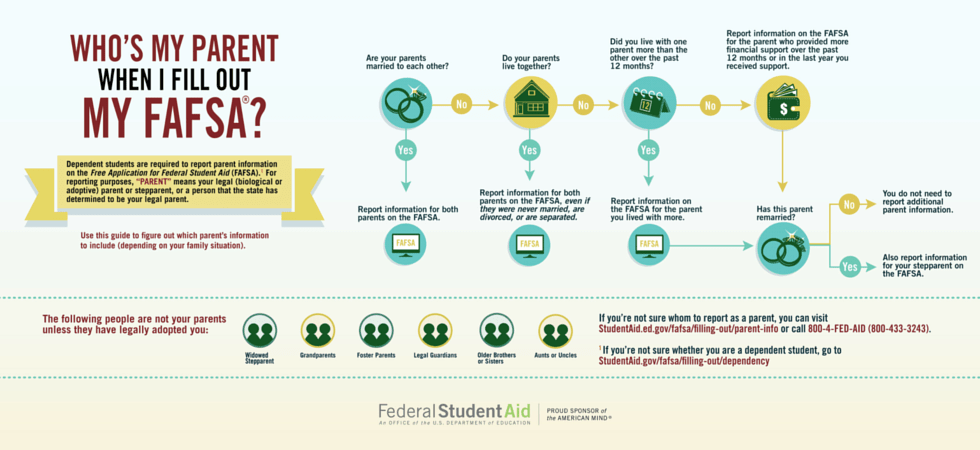

Need help figuring out who your parent is for FAFSA purposes? Here is the breakdown.
Via Federal Student Aid
All students who are considered dependent must have their parent or legal guardian provide information on the Free Application for Federal Student Aid (FAFSA). However, some students might have trouble figuring out who should fill out the FAFSA. For example, if parents are divorced or living apart, it may be confusing for the student to determine what parent’s information should be included. Here are some helpful hints to figure out what parent should fill out the FAFSA. Read More
Scholarship Saturday – January 23, 2016


The deadlines for the scholarships that were on this list have passed. To see scholarships that are still accepting applications, visit more recent Scholarship Saturday posts.
I haven’t filed taxes yet; how do I submit the FAFSA?
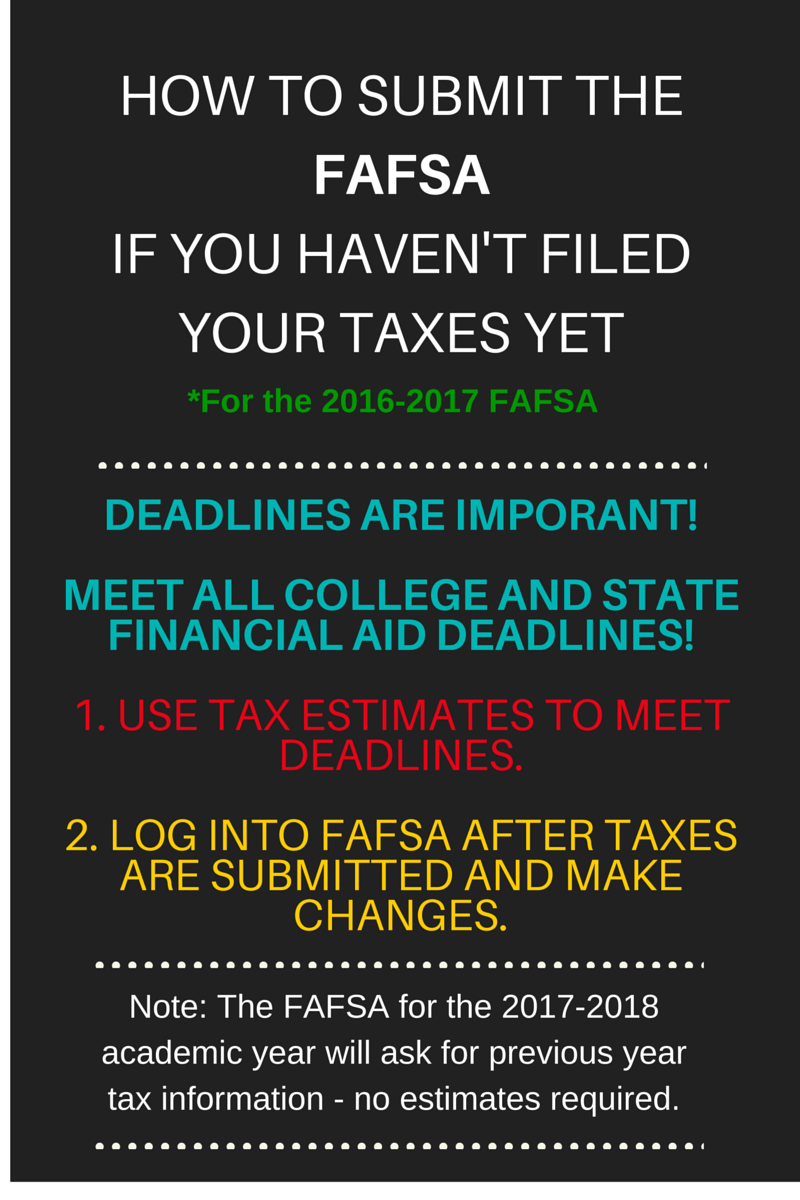
 FAFSA deadlines can be very confusing for students and their parents. Many colleges and states have financial aid deadlines in January and February, but most of us have not filed our taxes by those deadlines. So, how do you fill out the FAFSA when it asks for tax information?
Unfortunately, many families wait to submit the FAFSA until after they have filed their taxes and miss the financial aid deadlines at colleges. By submitting the FAFSA and financial aid documents just one day late, students can miss out on many financial aid opportunities, including grants and scholarships that do not need to be paid back.
To ensure students meet the financial aid deadlines, it is acceptable to provide estimates on the FAFSA. Students and families can base their estimates on their last pay stub, W-2s and other tax documents. In addition, if income has stayed somewhat consistent over the years, families can use the previous year’s federal income tax returns to make estimates. If your income has changed, FAFSA provides an income estimator.
The most important thing to remember when providing estimates on the FAFSA is go back after taxes are filed and make the necessary changes. The Department of Education has made it simple by providing the IRS Data Retrieval Tool (DRT) to transfer tax information directly into the FAFSA. If families choose not to use the DRT, they can log back into the FAFSA and manually enter the correct information.
Therefore, keep these things in mind to ensure you get the best financial aid offers from colleges:
- Pay attention and meet the specific deadlines for each college, as well as state deadlines.
- If you will not be able to file your taxes before the deadlines, provide estimates on the FAFSA.
- After filing your taxes, return to the FAFSA to submit corrections.
Note: In future years (starting with the 2017-2018 FAFSA), the FAFSA will be made available earlier. For example, for the 2017-2018 academic year, the FAFSA will be available Oct. 1, 2016 and students and parents will use their 2015 tax information to fill out the FAFSA. Estimates should not be required in the future since the FAFSA will use the previous year’s tax information.
Want to stay in the loop? Follow this blog to be notified when new articles are published. You can also follow me on Twitter, Facebook or Pinterest for information on college admissions.
Buy Me a Coffee

Book Pick of the Month

The link for the book is an affiliate link. You will not pay extra; however, I do receive a small reimbursement if you purchase through the links. Thank you for your support of JLV College Counseling.


 JLV College Counseling